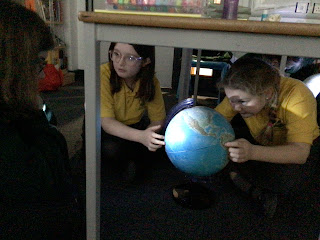
This week the children used globes to identify how the tilt of the Earth has an effect on the amount of light/ darkness in Northernmost part of Norway and Sweden which are north of the Arctic Circle. The polar nights lasts for about 28 days and the midnight sun can last for 50 days. The Earth is on an axis - 23.5 degrees. Which means that when the Earth is tilted away from the sun, there are parts of the northernmost points that do not receive any sun for parts. When the Earth is tilted towards the sun the northernmost points will receive sun most of the time. This was quite a tricky concept to learn so the children used torches and a globe to act out how the tilt has an effect of the Earth.
This week the children looked at a climate graph for London, Umea and Copenhagen. They began to discuss the climates of each country as well as recapping what climate means. They were then introduced to the Arctic Circle and a Birds Eye view of the Arctic Circle and the continents that can be found there. The children then used their atlas to label continents and oceans in the area and discuss their climate.
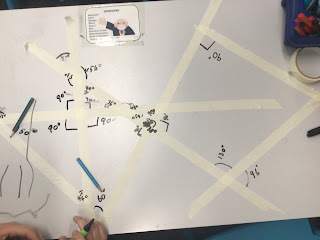
We have begun our journey about angles. The first few lessons have proved to be trickier than expected as the children were learning how to use protractors to measure various types of angles. We took drastic measures and taped up our desks so the children could work together measuring angles on their desks. Next week, we start looking at angles on a straight line and in shapes.





Comments
Post a Comment